
 1
The pineapples of Moorea surprise people. They are small, often no bigger than a large grapefruit, with golden flesh, a fragrance you notice from a metre away and a core tender enough to eat. Most of them are a variety known locally as Queen Tahiti, and the island has grown them for generations in the valleys behind its northern bays.
You do not need to visit a farm to taste them. They turn up on every fruit stand, in juices and sorbets, sliced on breakfast plates and stacked by the roadside in loose pyramids. Knowing a little about where they grow and how to choose one makes each one better.
Where the pineapples grow
The heart of pineapple country is the Opunohu valley, which climbs inland from Opunohu Bay towards the Belvedere lookout. Driving up, you pass fields of low grey-green plants in neat rows, each one sending up a single fruit on a short stalk. A large part of the valley belongs to an agricultural school, where students learn to grow pineapples, vanilla, citrus and vegetables, and where the slopes are kept as working farmland.
Smaller plantings fill parts of the Paopao valley behind Cook's Bay and the hillsides above some coastal villages. The plants like warmth, sunshine and well-drained soil, and the volcanic slopes give them all three. Each plant takes many months to produce its fruit, and growers stagger their planting so that some fruit is ready most of the year.
Further up the same valley, the forest closes in around the old marae. The trees here include mape, the Tahitian chestnut, whose large seeds are roasted or boiled and eaten in season.
How to choose a pineapple
A ripe Moorea pineapple smells sweet at the base. Pick it up: it should feel heavy for its size and give very slightly when you press the skin. The colour of the shell matters less than you might think, since some ripe fruit stays partly green, but a fruit that is golden from the base upwards is usually ready. Avoid any with soft, wet patches or a sour, fermented smell.
Sellers at the stands are usually happy to choose one for you if you say when you plan to eat it. Many will also peel and cut a fruit on request, which saves you carrying a knife. Prices are modest by local standards but vary through the year; carry small notes and coins in Pacific francs.
- Eat the core: on a ripe Moorea pineapple it is soft and sweet.
- Store cut fruit in a cool bag and eat it the same day.
- Wash your hands afterwards; the acid can sting small cuts.
Roadside stands and what else they sell
Fruit stands on Moorea range from a folding table under a tree to a small wooden hut with a roof of corrugated iron. Most sit along the coast road, especially near the bays and on the stretches between villages. What they sell depends on the season and the garden behind the house.
Also on the menuA fruit-stand guide: mango, uru, papaya and pamplemousse
Alongside the pineapples you are likely to find bananas of several kinds, including small sweet ones and cooking bananas, papayas, limes and green coconuts for drinking. In the warm, wet months, roughly from November to March, mangoes appear in heaps, along with rambutans and avocados. Starfruit, soursop and the large, mild pamplemousse, a Polynesian pomelo, come and go. The fruit-stand guide explains how to pick and eat each of them.
Some stands also sell uru, breadfruit, either raw or already roasted, and bunches of fresh herbs. Honesty boxes are common: the price is written on cardboard and you leave the money in a tin. Pay the amount shown and take only what you paid for.
Juice, sorbet and the island's kitchens
Pineapple juice from Moorea fruit is sold across French Polynesia, and fresh-pressed juice turns up at snack bars and markets on the island. It is thick, fragrant and less sharp than juice from larger varieties. Mixed with lime and a little coconut water, it makes the best cold drink of a hot afternoon.
In island kitchens, pineapple goes into more than dessert. It appears in sweet-and-sour dishes from the Chinese-Tahitian tradition, in marinades for pork and chicken, and occasionally in poe, a thick, sweet pudding made with fruit, starch and coconut cream. The guide to the Chinese-Tahitian kitchen has more on that side of the island table.
The valley beyond the fields
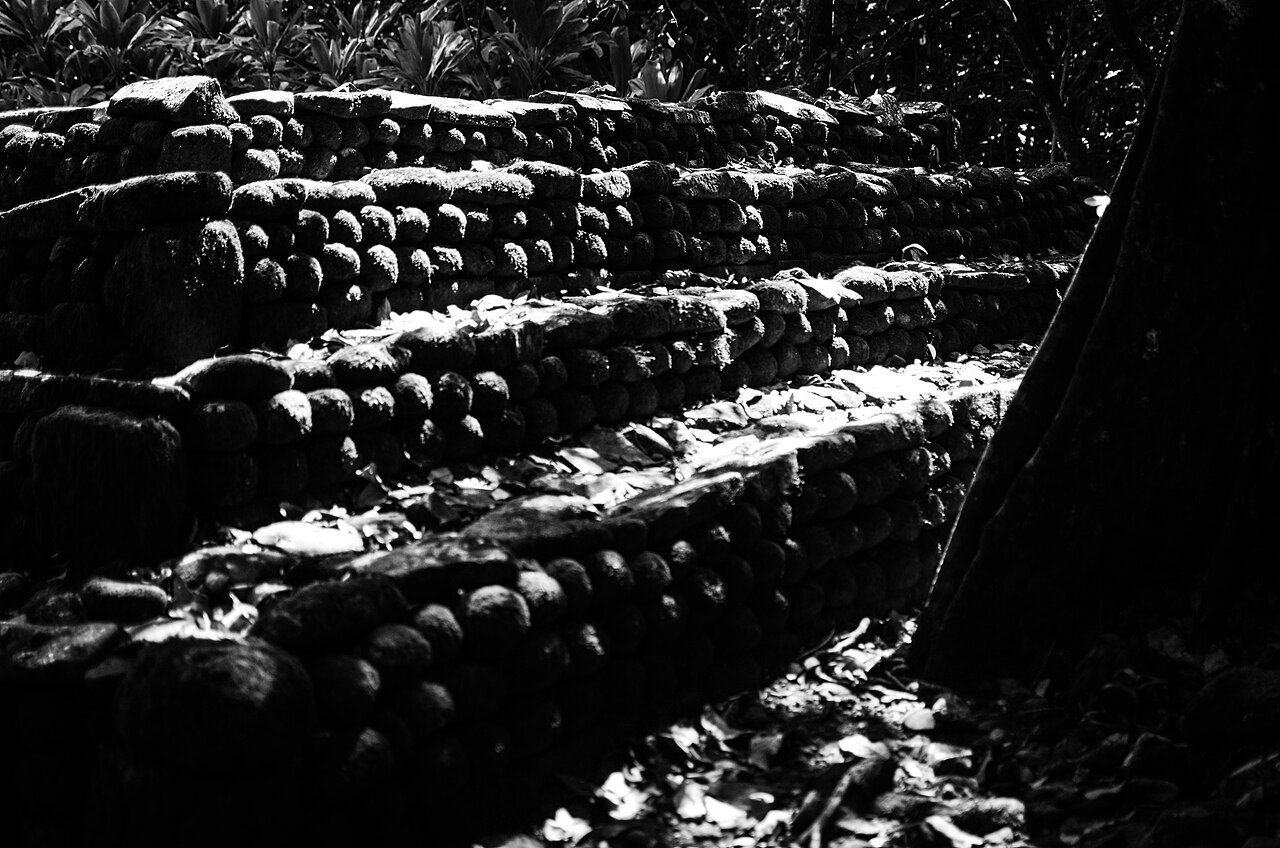
Keep driving uphill past the fields and the valley changes character. The farmland gives way to forest, and the air cools a little. Here are the marae of the Opunohu valley, the stone platforms and enclosures of earlier Polynesian society, scattered among tall trees. Some lie beside the road; others are a few minutes' walk along a marked path.
These are sacred places. Walk around them, not across them, and leave stones exactly where they lie. Above them, the road reaches the Belvedere, the lookout over both northern bays described in the story on Cook's Bay and Opunohu Bay.
Bringing fruit back and when to go
Moorea fruit makes a good gift for the ferry ride back to Tahiti, but check the rules before you carry fruit or plants further afield. Biosecurity controls apply when you travel between some islands and when you leave French Polynesia, and fresh fruit is often restricted. Ask at the ferry or airport if you are unsure.
Pineapples are on sale through most of the year. The season for other fruit is less predictable, since a dry spell or a storm can change what reaches the stands. The simplest rule is to buy whatever looks best on the day, eat it within a day or two, and go back for more.